



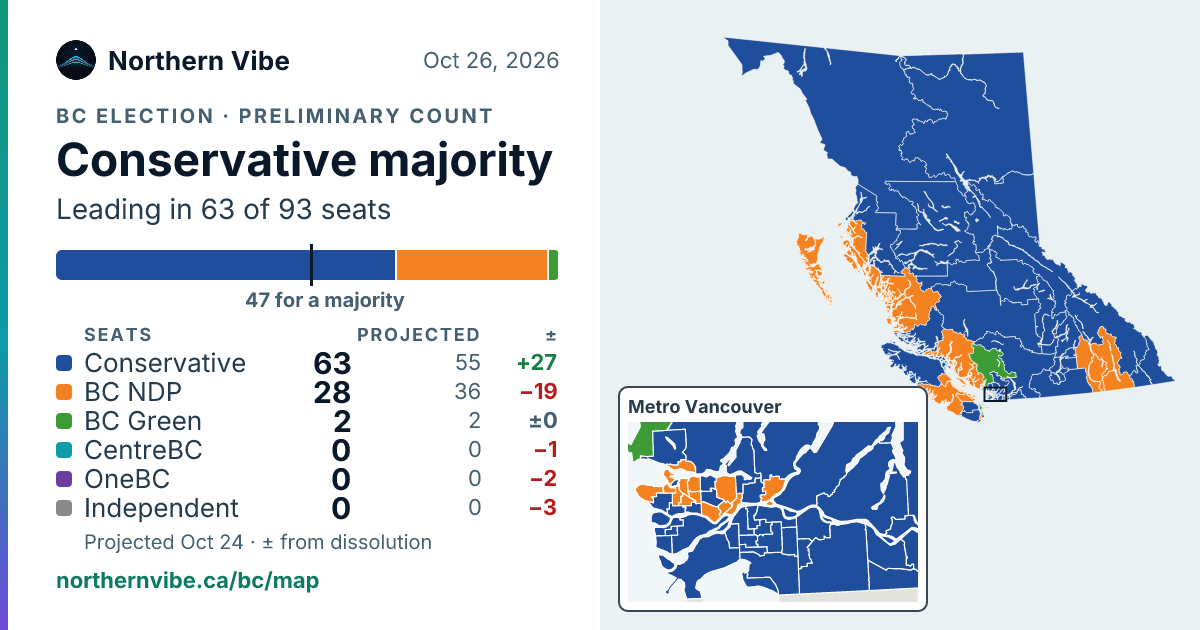
On Saturday, October 24th, British Columbians elected a Conservative majority, the province’s first Conservative government in more than 90 years. At the preliminary count, Lorne Doerkson’s BC Conservatives lead in 63 districts compared to the BC NDP’s 28. The BC Greens hold on to 2 seats. In the BC legislature, a majority requires 47 seats.
Since Saturday, one idea has been everywhere: add the NDP and Green votes together and they beat the Conservative winner in about a dozen districts. That’s true, but it assumes those Green voters would otherwise have voted NDP. Even if all of them had, the Conservatives would still have secured 51 seats, a majority.
The vote split on the left is actually the smaller story.
The bigger number
CBC’s Justin McElroy compared this year’s vote with 2024, leaving out mail-in ballots in both years. In this year’s provincial election, the NDP received about 228,000 fewer votes than in 2024, a drop of more than 25%, losing votes in 86 out of 93 districts. Preliminary turnout fell to 48%. If that holds once mail-in and absentee ballots are counted, CBC notes it would be the first time since at least 1949 that turnout has dropped below half. The BC Conservatives received about 22,000 fewer votes, while the Greens received about 30,000 more than in 2024.
Most of this year’s Green vote isn’t new. On the same count, the Greens got about 166,000 votes in 2024, and the NDP still won a majority government. What is new is the extra 30,000 Green votes (about 18% more). So the question has been asked (a lot):
What if all of the new Green votes had gone to the NDP instead?
If they had, the NDP could have won up to four additional seats: Vancouver-Fraserview, Burnaby North, Burnaby Centre and Saanich South. In the two Burnaby seats, the Greens didn’t even run a candidate in 2024.
Now run the same exercise with the NDP’s own 2024 voters. If the NDP had won back just half of the 2024 voters it lost, it would have flipped 11 districts, one more than if three in four of all Green voters had switched to the NDP. If the NDP had kept all of its 2024 voters in 2026, it would have won 19 more seats, leaving the Conservatives at 44, three short of a majority.
Where did the NDP voters go?
Results by district can’t tell us how any one voter cast their ballot, but the overall pattern is hard to miss:
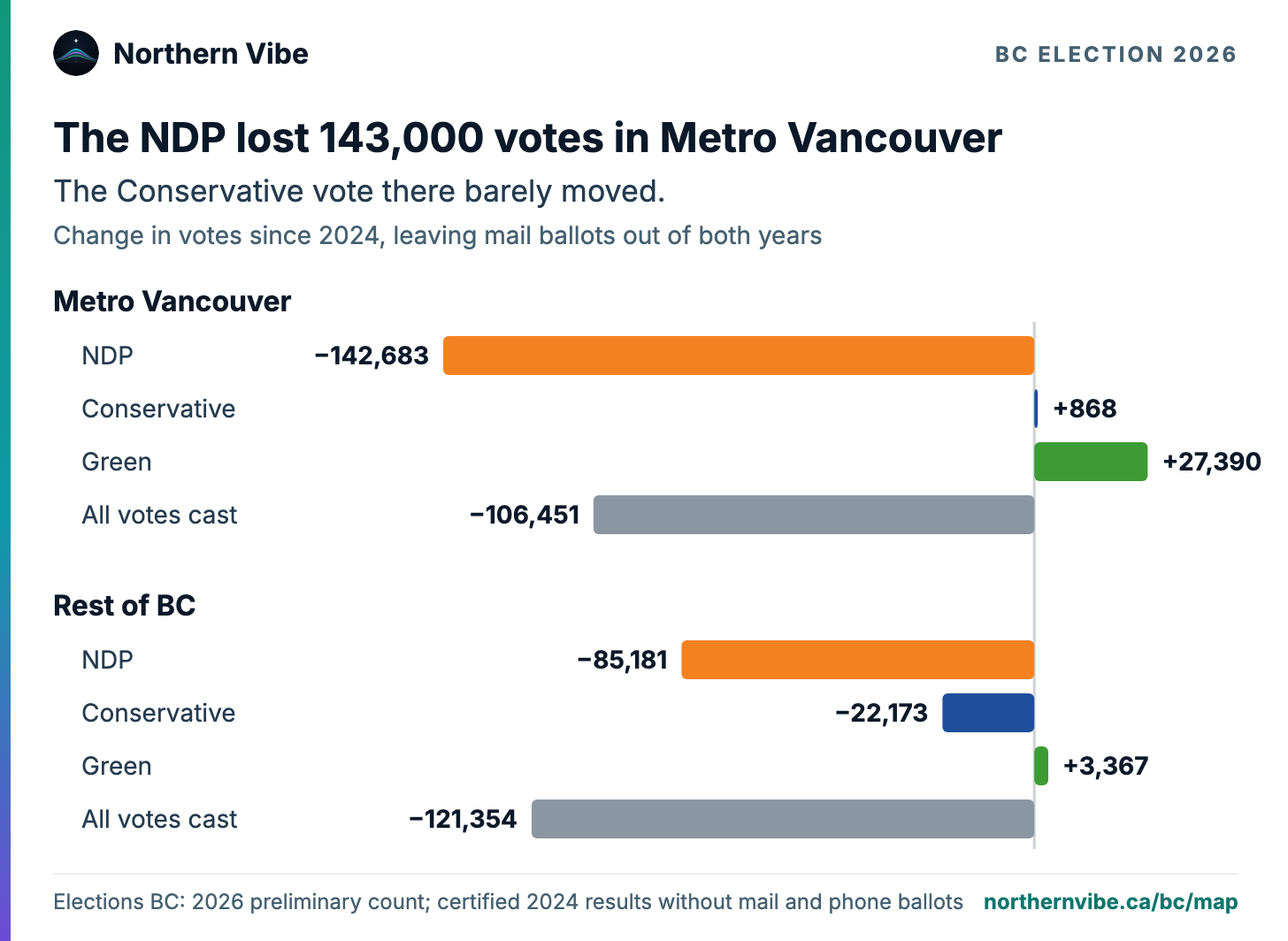
In Metro Vancouver, the Conservative vote barely moved, up about 1,000. The NDP’s fell by nearly 143,000. Some NDP voters went Green; the Green vote there rose about 27,000. The total vote in Metro fell by about 106,000, so more NDP voters appear to have stayed home than switched to voting for another party.
Outside Metro Vancouver, both big parties lost votes: the NDP lost about 85,000 and the Conservatives lost about 22,000.
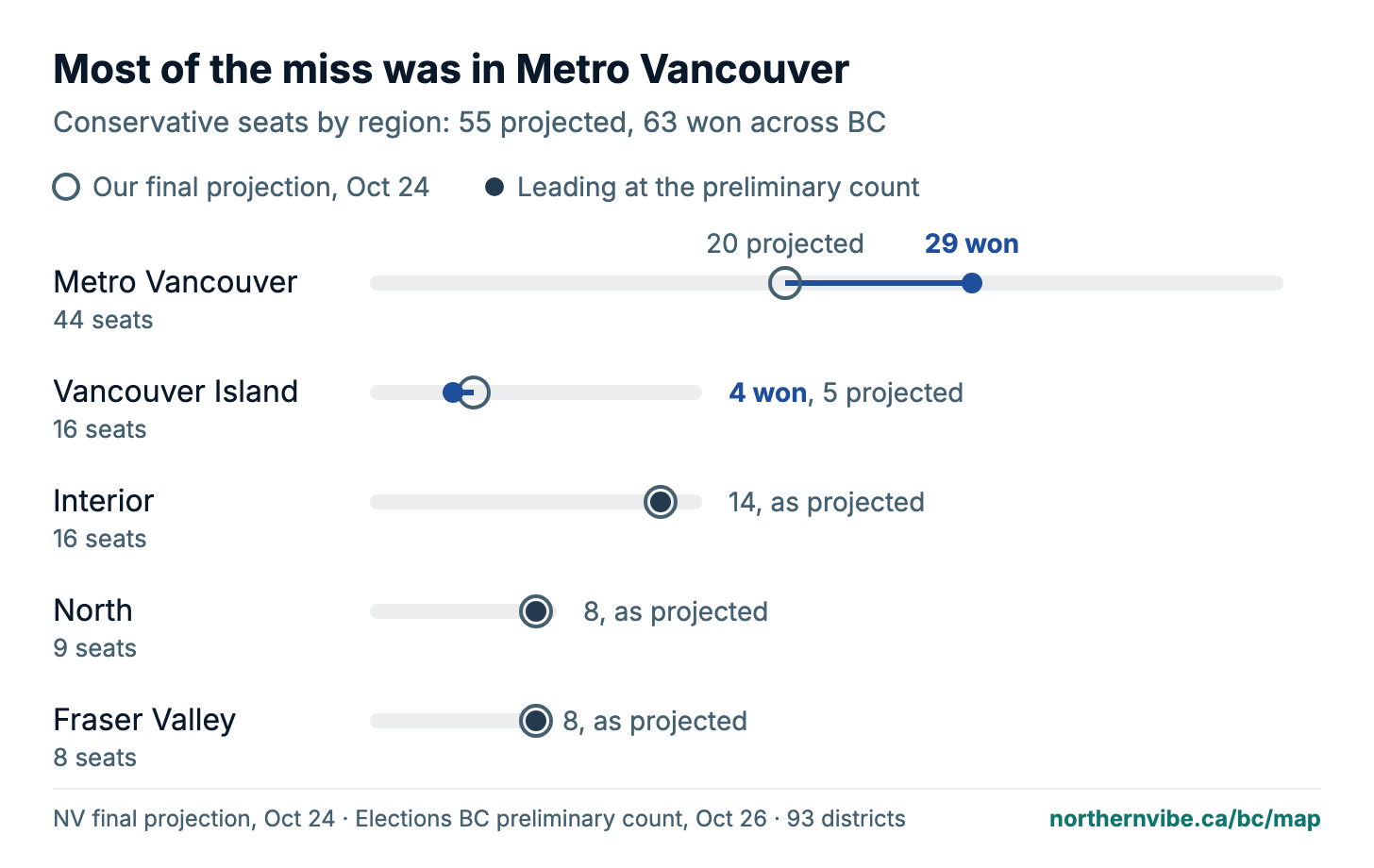
The swing was much larger in Metro Vancouver, where the NDP lost almost a third of its vote, compared to about a sixth on Vancouver Island. This is also where the Northern Vibe model, which moves every district with the provincial polls, missed the most. In every other region, it was within one seat of the result.
These are preliminary results. Mail-in and absentee ballots are counted November 6 to 10. Our final projection for every district is still available at northernvibe.ca/bc.
The NDP didn’t lose BC to the Greens. It lost the voters it already had.
Stay curious,
Matt and Caitlin, from The Northern Vibe Project
Contact us at contact@northernvibe.ca
The Northern Vibe Project is not affiliated with Elections BC and isn’t a source of official results. Results here are Elections BC’s preliminary count as of 10:34 a.m. on October 26, when the initial count was complete, compared with Elections BC’s certified 2024 results without mail and telephone ballots. For official results, head to elections.bc.ca.