



British Columbians head to the polls in thirteen days, and the race looks very different from when we launched our BC coverage two weeks ago. Back then, our model gave the BC NDP the slightest of edges at 46 seats, one short of a majority. Today, it puts the BC Conservatives ahead: 52 seats to the NDP's 39, with the Greens holding on to 2. In the BC legislature, a majority requires 47 seats.
This is a lean, not a lock, in a race which has ebbed and flowed over the past few weeks. The outcome of this election is far from settled. The Conservatives win a majority in about three out of every four simulations (73%), and the NDP get the majority in roughly one in five (19%) simulations. Campaigns matter, and all the parties are working hard to sway public opinion.
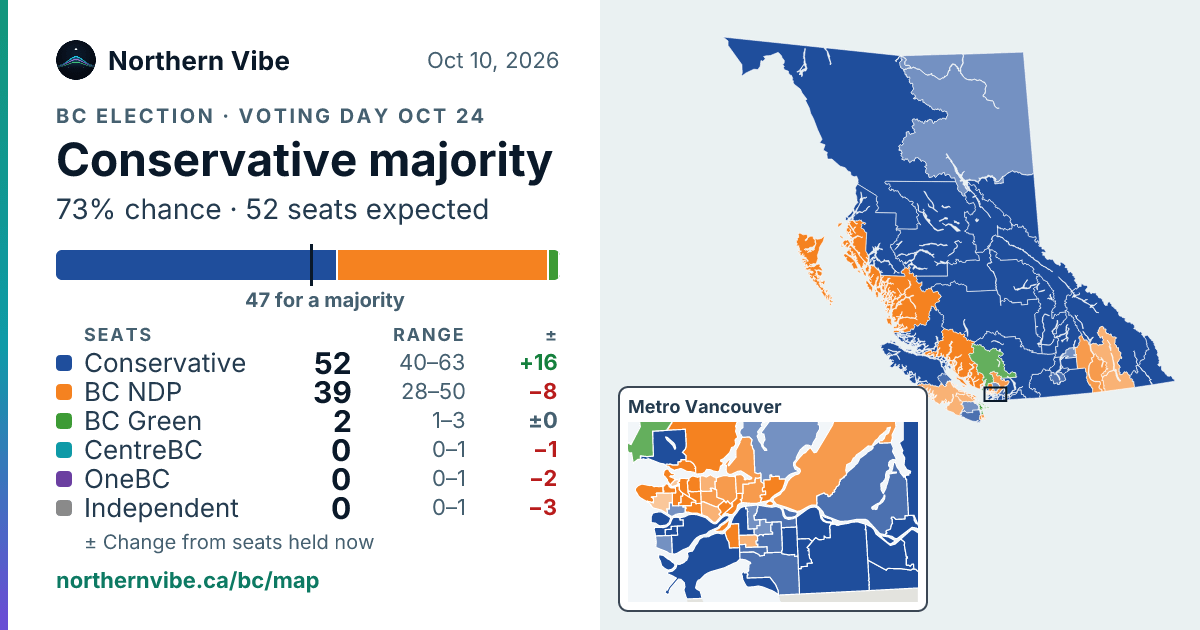
Our polling aggregate has the Conservatives ahead at 42% with the NDP just behind at 39% and the Greens at 10%. Three points doesn’t sound like much; however, in a province where a long list of seats came down to a few hundred votes in 2024, three points is more than enough to influence the outcome. Those are the seats we’ve been writing about each morning (@northernvibe.ca). Follow us on Threads for daily updates on the state of the race.
The close races so far
Four seats were decided by fewer than a hundred votes in 2024. Today, all four of those now lean Conservative.
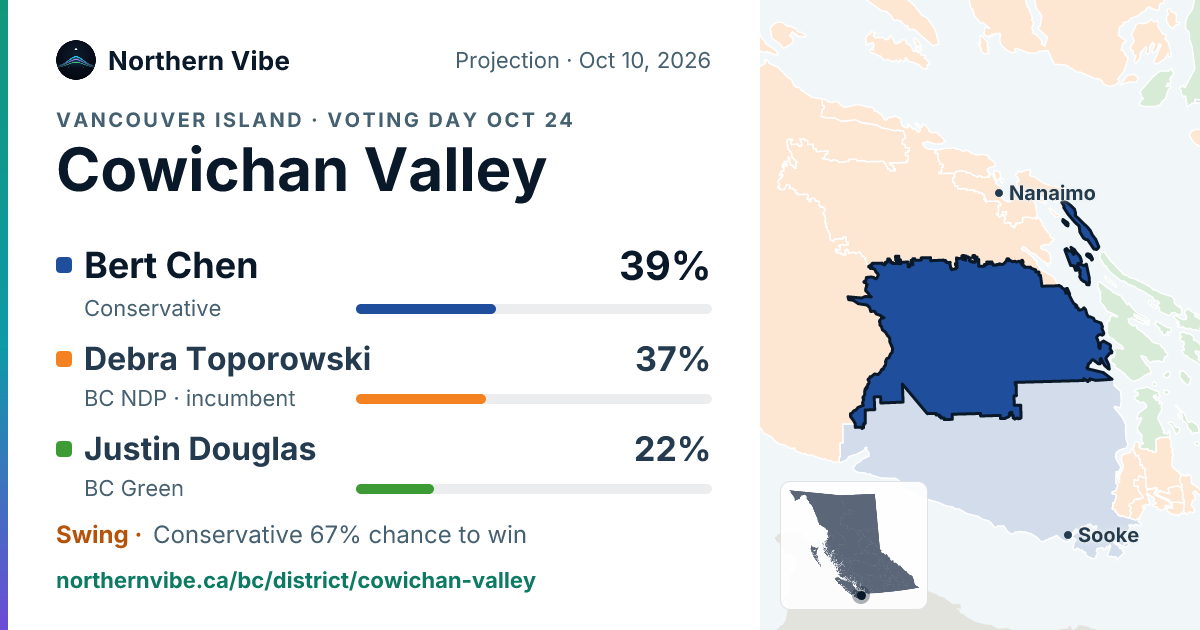
Surrey-Guildford: 22 votes was the margin of victory for the NDP's Garry Begg in 2024, and it took a judicial recount to confirm it. This time he faces Conservative Garry Thind, and our model rates the seat a LEAN for the Conservatives, with a win probability just north of 80%.
Kelowna Centre: 40 votes, and now a rematch. Conservative Kristina Loewen and the NDP’s Loyal Wooldridge are both back on the ballot.
Courtenay-Comox: 93 votes was the margin for the Conservatives. Brennan Day defends it against the NDP’s Will Cole-Hamilton.
Maple Ridge East: a flip by just 97 votes. Lawrence Mok defends it for the Conservatives against the NDP’s Hudson Campbell.
When the centre-left vote splits
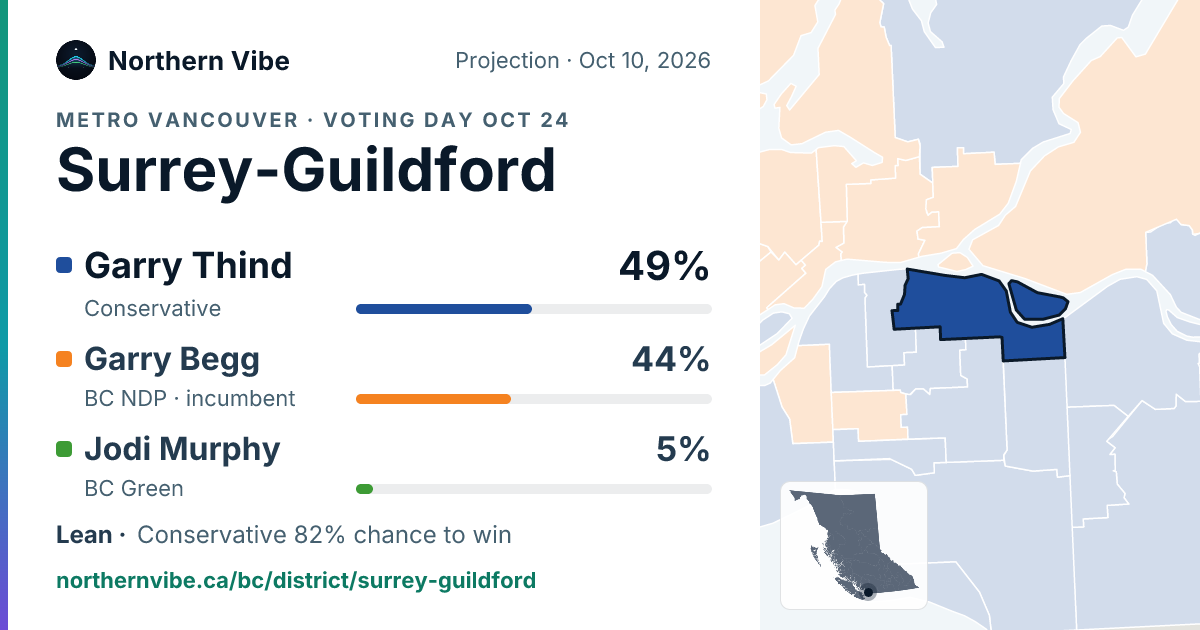
On Vancouver Island, Juan de Fuca-Malahat and Cowichan Valley are a reminder that BC isn’t a two-party province. Cowichan Valley was actually held by the Greens until 2024.
Now the Northern Vibe model has the Conservatives narrowly ahead in both of those seats:
Cowichan Valley: roughly 39% Conservative, 37% NDP and 22% Green.
Juan de Fuca-Malahat: 38% Conservative, 33% NDP, and 24% Green.
When the centre-left vote splits, a party with north of 30% of the vote can win the district. Where Green voters land in these two seats will tell most of the story on election night.
Candidates who changed the race
In Vernon-Lumby, Kevin Acton ran as an independent in 2024 and took 15% of the vote, while the NDP’s Harwinder Sandhu held on by 476 votes. This time Acton is running for the Conservatives, with the NV model projecting a narrow lead.
Coquitlam-Burke Mountain was decided by just 368 votes, a rare straight two-way race in 2024. This year, the Greens and CentreBC are on the ballot too, and the model tips it narrowly to the Conservatives as the NDP’s Jodie Wickens defends it against Ryan Peterson.
The NDP-held exception
Not every close seat leans Conservative. Vancouver-Yaletown is the tightest race on our list where the model still favours the NDP. Terry Yung held it by about 1,200 votes in 2024, and today the projected gap between him and Conservative Margareta Dovgal is less than a single point.
As with many elections, the overall provincial numbers matter less than the small local stories. This is why The Northern Vibe Project models every district with its own page and share card at northernvibe.ca/bc, updated as new polls come in.
A few hundred votes in the right places will decide who governs British Columbia.
Stay curious,
Matt and Caitlin, from The Northern Vibe Project
Contact us at contact@northernvibe.ca
The Northern Vibe Project is not affiliated with Elections BC and isn’t a source of official voting information. For where and how to vote, and what ID to bring, head to elections.bc.ca.