



Walk the streets of Edmonton Strathcona outside the University of Alberta and you may be forgiven for not knowing you are in Wild Rose country.
Stop outside a local coffee shop on Whyte Avenue and you’ll see crosswalks painted in rainbows, bike lanes, used bookstores, and maybe even a local farmers' market. Within a few city blocks you can find both a university campus of forty thousand and the health-sciences complex adjacent it, containing a teaching hospital, children's hospital, and a cancer institute.
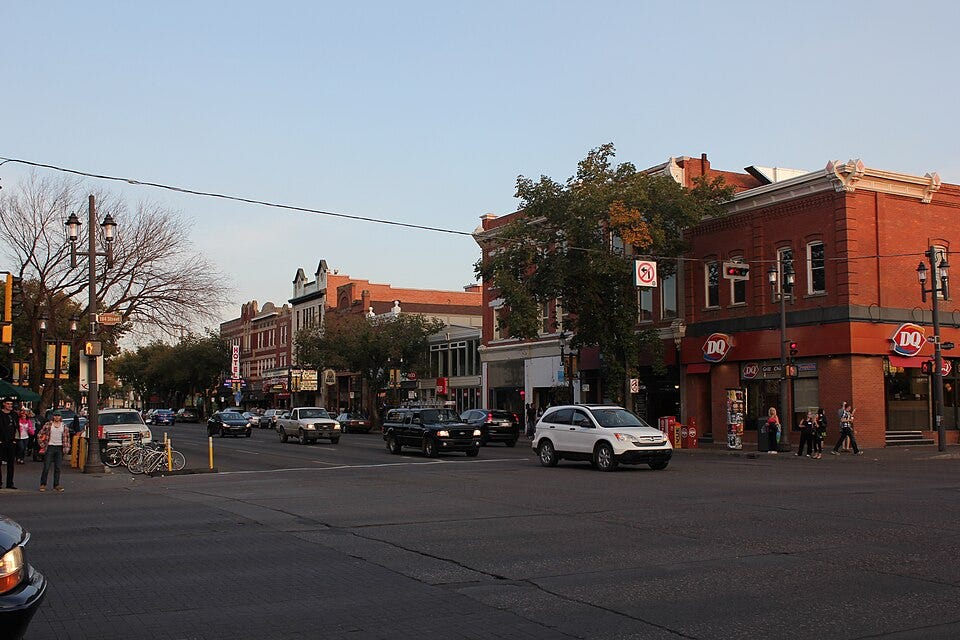
Old Strathcona, looking east from 104th Street, Edmonton. Photo: Arctic.gnome, CC BY-SA 3.0, via Wikimedia Commons.
However, In 2025, Alberta sent the vast majority of its 37 members of parliament to Ottawa under the blue Conservative banner. Edmonton Strathcona has sent one of the lonely exceptions, in one form or another, for the better part of two decades.
The most Conservative province in Canada is also home to the single safest NDP seat in the country.
The demographics of this riding are the engine that drives the progressive narrative. Edmonton Strathcona is one of the youngest ridings in the country (29% under 35, 14th of 343) and one of the most educated, with nearly one in five residents holding a postgraduate degree (top 11% nationally) and almost half a bachelor’s or higher. The economy runs on the university campus and in public services: 35% of workers are public sector, the 39th-highest share in Canada. Nearly half the households rent, and nearly half have moved in the past five years, reflecting a more credentialed, transient electorate. Incomes are comfortable rather than wealthy (median $60,000), but this was never a story about money. It’s a story about the people who call this riding home.
The orange exception has a long lineage. Strathcona spent the Reform–Alliance years Conservative under Rahim Jaffer, who took it in 1997 and held it for more than 10 years. Then, in 2008 Linda Duncan won it for the New Democrats. For much of the decade that followed it was, more often than not, the only seat in Alberta the Federal Conservatives could not win. Duncan held it both through the 2011 Conservative majority under Stephen Harper and the 2015 Trudeau-Liberal wave. When she retired from federal politics in 2019, Heather McPherson, someone who spent their time in international development circles and running the Alberta Council for Global Co-operation, a coalition of aid and development NGOs, has kept it firmly orange ever since.
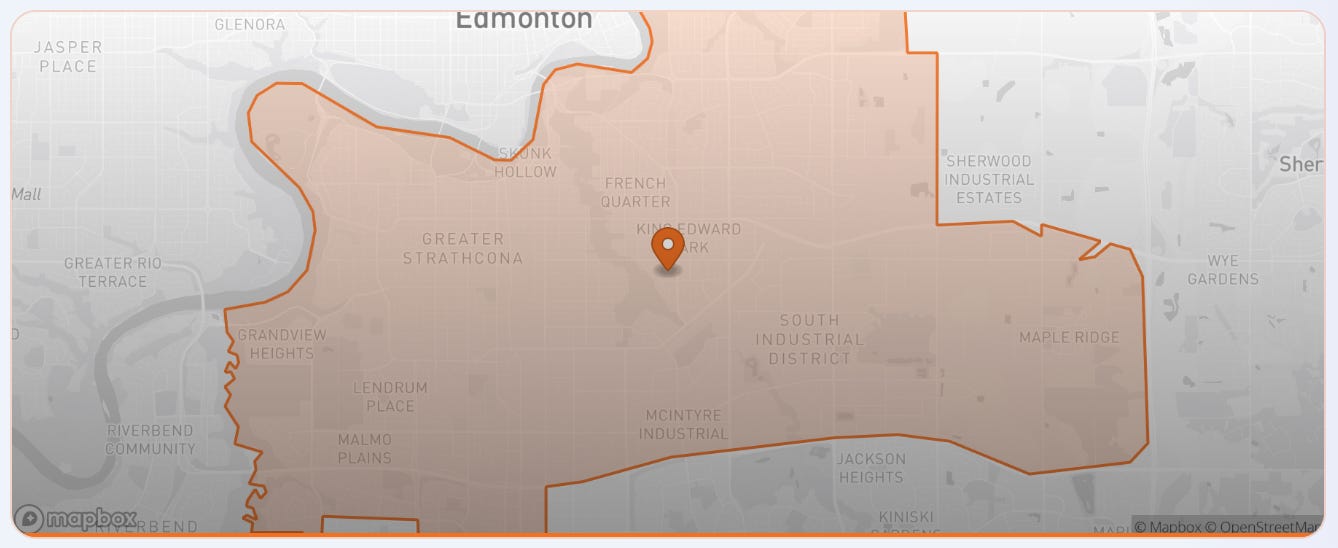
Seat projection by The Northern Vibe Project; base map ©Mapbox ©OpenStreetMap.
During McPherson’s tenure, the seat wasn’t just seen as safe, but a fortress. In 2021 McPherson took 58% of the vote, a 31-point margin, followed in 2025 by a thinned victory falling to 47%, a margin of 14 points. It wasn’t a Conservative surge, the CPC had a small positive nudge in the riding, but the Carney-Liberal wave nearly doubled the LPC vote share here from 9% to 18% and pulled soft New Democrats toward a Liberal government.
This shrinking vote share exposes some cracks in the local NDP’s ability to hold the young, progressive core around campus and Old Strathcona as the more conservative-suburban ground to the south and east continue to be true blue. The seat didn't change character in 2025. The Liberal red wave just made its seams visible.
The Northern Vibe model still calls the seat comfortably in favour of the NDP. No realistic simulation turns this into anything resembling a contest. In fact, by the ballots already counted in 2025, this is now the safest New Democrat seat in the country.
Edmonton Strathcona is somewhat of a microcosm for Canada - while still holding onto power, significant ground was ceded to the Carney Liberals nationally. The New Democrats weren’t just beaten; their representation in parliament was halved and then halved again down to seven seats (below the twelve needed for official party status). This reflected the worst result for the party since 1993. After the dust settled, McPherson was one of the few left standing, and she ran to lead what remained of her party. However, in March 2026, in the NDP convention in Winnipeg, she lost decisively, 56% to 29%, on the first ballot to Avi Lewis: a movement-left candidate, and grandson of an NDP founding leader.
This story shares the lesson of Swift Current, read backwards. There, the province that invented social democracy produced the country’s most entrepreneurial, most Conservative seat written across fields of canola. Here, the Conservative heartland produced the country’s safest New Democrat seat written across a campus, university hospital, and a few square kilometres of renters who have spent two decades voting differently from the tides of CPC blue swirling around them.
Two prairie ridings, each the exception that defines its province.
Stay curious,
Matt, from the Northern Vibe Project
Edited by Caitlin
Do you live in this riding? Let us know what its like!
Want to see your riding featured next? Let us know!
Contact us at contact@northernvibe.ca