


Head just north of the historic North Toronto Subdivision, where the passenger rail used to connect Toronto and Montreal, and you will find yourself in the heart of Midtown Toronto. Formed from the old Town of North Toronto that was amalgamated into the city proper in 1912, Midtown is a dynamic core that consists of bustling neighbourhoods with character and stability of their own. It is also where the high-rises of Yonge and Eglinton coexist with quaint character homes along St. Clair and Forest Hill, as well as mum-and-pop shops in Mount Pleasant and Little Jamaica. These dynamic neighbourhoods make up the riding of Toronto-St.Paul’s.
Toronto-St. Paul’s is one of the most affluent, white-collar constituencies in Canada, with both the highest median income ($105,400) and second-highest percentage of financial and professional industries (31.6%). There is a certain degree of financial stability that has been a longstanding constant here, one where the newer professional class on Yonge and Eg meet lifelong residents in Forest Hill and St. Clair.
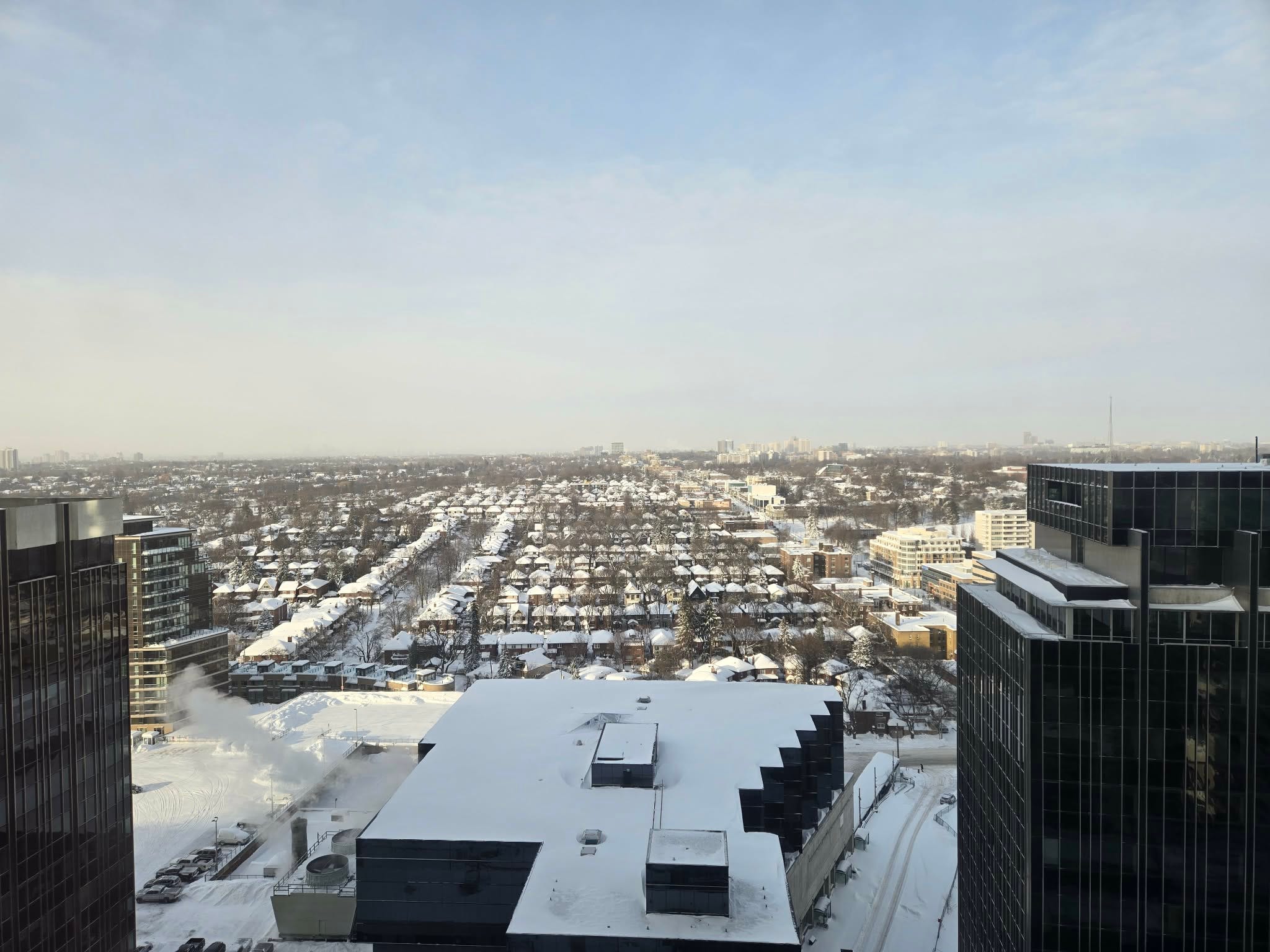
Forest Hill, taken from Home. Photo: H.Y. Jeong, 2026.
But it’s also a riding where the affordability question remains stark as the city continues to grow. Not only are three-fifths of the population renters here (58.9%), almost two-fifths also qualify as shelter-stressed (35.8%), indicating over 30% of the income spent on housing. With both metrics putting the riding within the 90th percentile, affordability continues to be a challenge, as the desirability of Midtown, both in its proximity and separation from Downtown, continues to extend from Downtown Toronto and across the province.
At the same time, Toronto-St. Paul’s remains a dynamic constituency with a diverse voting base, featuring considerable Latin American, Afro-Canadian and Filipino bases on the western and southwestern tip of the riding facing Davenport and Eglinton-Lawrence. But it is perhaps best known for the fifth-highest percentage of Jewish population in Canada (15.1%), with historic congregations and schools located in the heart of the community. As with neighbouring Eglinton-Lawrence and Don Valley West, events in recent years, whether it’s geopolitics or hate crimes motivated by antisemitism, have no doubt seen constant challenges in public safety and voter intentions.
All of these factors above have made Toronto-St. Paul’s, even with its particularly high-income, white-collar profile, one worth following in terms of the local and national sentiments.
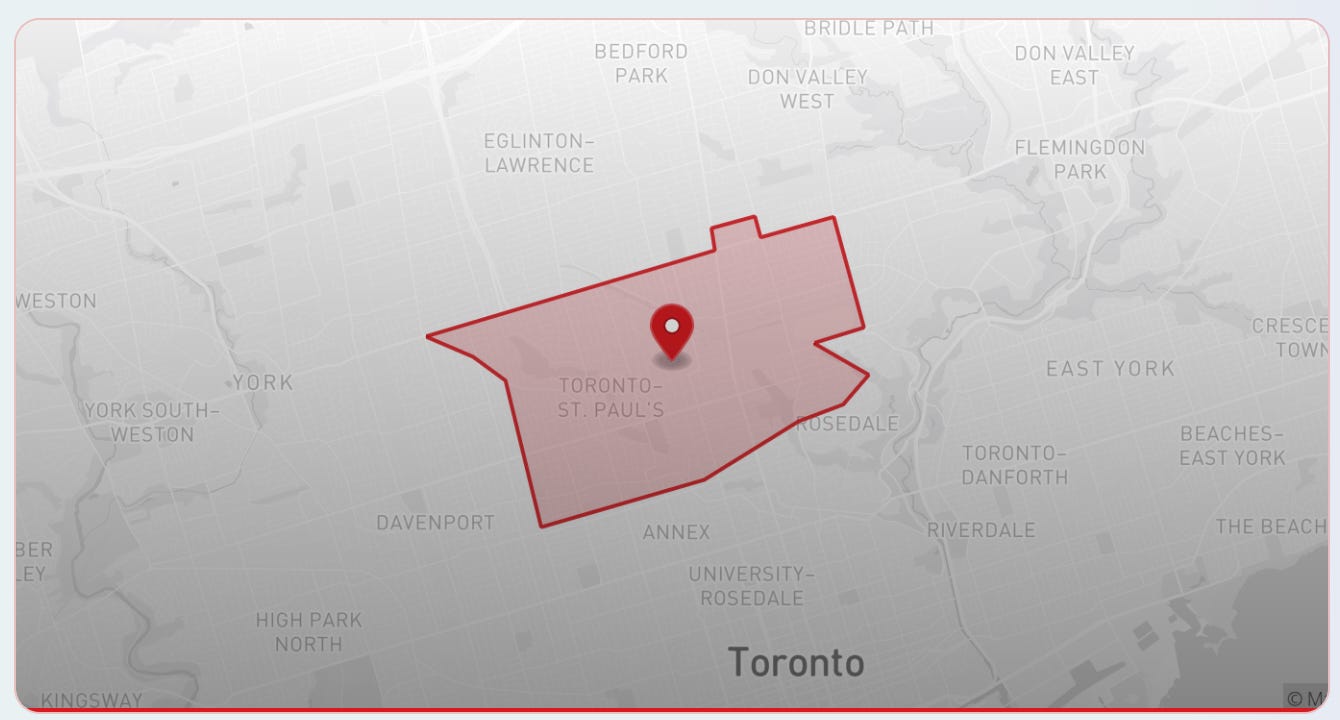
Seat projection by The Northern Vibe Project; base map ©Mapbox ©OpenStreetMap.
In recent decades, Toronto-St. Paul’s has been reliably red for most of the last thirty years. With a strong concentration of high-income, white-collar population with progressive values, it reflects not only the Red Tory tendencies of the riding, but also the barometer of the Liberal party’s strength nationally. Municipally, it is home to high-profile Liberal-leaning councillor Josh Matlow, whose local popularity is the envy of town. Provincially, New Democrats had two close wins in 2018 and 2022, during the Ontario Liberals’ trip to the wilderness, before it flipped back with a considerable margin in 2025 (+9.1%).
Federally, a similar line of expectation has followed, though unlike a steady change in representatives at the provincial level, most nowadays would associate Toronto-St. Paul’s with Dr. Carolyn Bennett. Bennett, a longtime physician, would go on to represent the riding from 1997 to 2024, her local strengths perhaps best demonstrated by a comfortable margin of victory (8.2%), even as the Liberals suffered a historic defeat in 2011, the same year I arrived in Canada. Her experience and services were valued significantly, as would the constituency’s strategic importance, as Bennett would go on to serve extensively in the Paul Martin and Justin Trudeau cabinets in the Public Health, Crown-Indigenous Relations, and Mental Health portfolios.
Needless to say, a departure of such a high-profile figure, whose longevity overlapped with that of Dr. Hedy Fry, Lawrence MacAulay and John McKay, has no doubt raised some caution. There was a brief blip in 2024 following a highly televised by-election, where the Liberals suffered a national embarrassment. Both the riding-level discontent over public safety and the national-level furore over affordability concerns played heavily on the said by-election, the first of three consecutive by-election losses in a six-month period that would mark the beginning of the end for the second Trudeau era (one of the major events noted in the Northern Vibe Accountability tracker).
Two years later, however, most of the variability seemed to have settled. When the time came again for 2025, Leslie Church, a former Toronto lawyer who had served as chief of staff under then-Liberal Deputy Prime Minister Chrystia Freeland, took 62% of the vote, nearly double-scoring the Conservative incumbent at the time. Unlike other constituencies we’ve covered so far, this story didn’t include a significant drop in New Democrat votes. In pervious by-elections in the riding the share of New Democrat voters dropped from 11.0% to just 3.5%, which amplified their steady decline in popularity in the past decade.
Rather, the change in national sentiment under the Carney era shows a relatively similar trends to those in suburban constituencies. Just over a year and many moons removed from the federal by-election, the Northern Vibe model remains as SAFE as it’s ever been with a projected LPC 63% / CPC 26% / NDP 6% / GPC 3%.
Little has changed in terms of Liberal numbers, though where the New Democrats gained, the Conservatives stumbled, reflecting numbers closer to their 2006, 2008, 2015 and 2021 results. It’s a telling sign, that the riding remains strongly Liberal, especially since this particular riding absorbs the tendencies exhibited from both Toronto proper and its neighbouring suburbs, which were joined in the 1998 Amalgamation of Metropolitan Toronto. It also reflects a similar story that we have already seen in both University-Rosedale and Scarborough Southwest by-elections.
Two years after a national humiliation for the outgoing government, the notion of a Liberal Fortress in Toronto has quietly returned under the new management, perhaps with the best demonstrable example in the riding of St. Paul’s.
Stay Seeking,
Henry, from the Northern Vibe Project
Edited by Caitlin
Do you live in this riding? Let us know what it’s like!
Want to see your riding featured next? Let us know!
Contact us at contact@northernvibe.ca