



Brantford is a city of early Canadian dreams. While the most famous figure to have come from here is Wayne ‘The Great One’ Gretzky, Brantford and the county of Brant’s historical origins go way back, owing their beginnings to the legendary chief Thayendanegea (Joseph Brant) and the Mohawk people. Their 1784 settlement in the region under the Haldimand Tract would be best known in the Six Nations reserve, the largest First Nations settlement in Canada, which borders Haldimand-Norfolk to the south. This is Brantford Brant South-Six Nations.
Located at the heart of the Grand River, and with access to railway connections across southern Ontario, its industrial significance took off early thanks to its location. Brantford grew heavily in manufacturing, especially in agricultural machinery, where companies such as Cockshutt Plow, Massey-Harris, and Waterous Engine Works helped fuel the rise of the local economy. Even in current times, when much of Southwestern and Midwestern Ontario has seen significant industrial decline over the last fifty years, manufacturing remains prominent here in Brantford Brant South-Six Nations, with just over one-sixth of the workforce employed in manufacturing (17.6%, 15th of 343), even as the public sector remains on top with 22.9% of employment in the constituency.
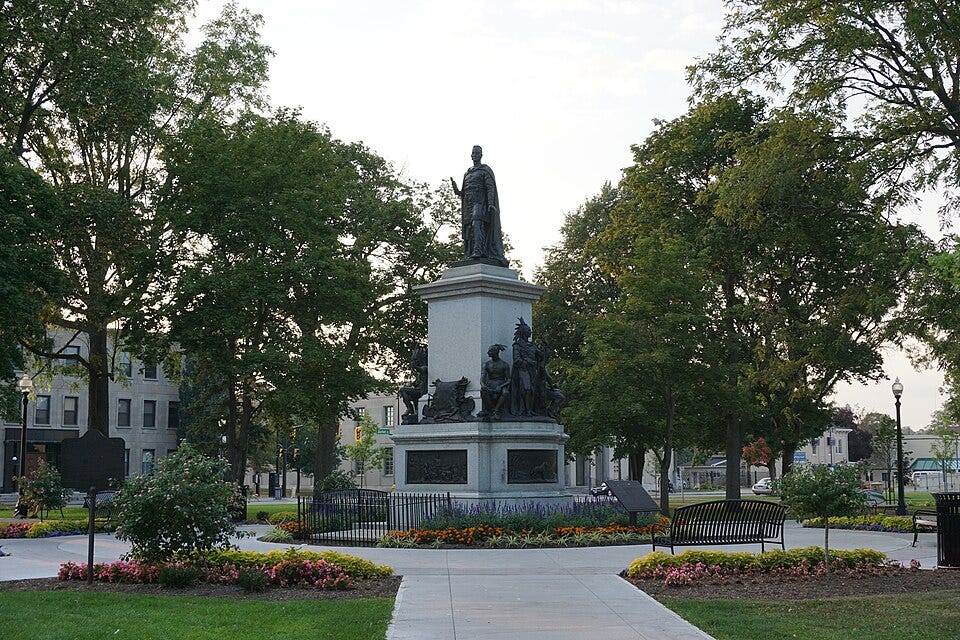
The Joseph Brant Monument in Victoria Park, downtown Brantford. Photo: Reacher Miao, CC BY-SA 4.0, via Wikimedia Commons.
On the surface, Brantford-Brant South-Six Nations (shortened as Brantford-Brant, its predecessor) appears to be a simple, rural-urban riding where the Conservatives hold a fairly firm grip with the other parties trailing behind. While it is true the Conservatives have held this constituency since the 2008 Canadian Federal Election, the picture isn’t so straightforward when you look into it further. The era-by-era changes reflect in a more gradual, even slightly delayed manner on what’s a mid-juncture between Hamilton and the Niagara region in the Golden Horseshoe, and southwestern Ontario.
Its provincial and federal pictures slightly differ, in part because Brantford has local actors that have no doubt defied the trends otherwise shown in the province. Provincially, the Ontario Liberals’ pre-2018 dominance was led by long reigns of three figures, in both Harry and Robert Nixon’s reign from 1919 to 1991, as well as that of Dave Levac from 1999 to 2018. As Ontario Liberals all three figures have held significant capacities, with the elder Nixon’s brief tenure as Ontario Premier, the younger Nixon’s party leadership in the 1970s and later tenure as Deputy Premier under David Peterson, and Levac’s tenure as the House Speaker from 2011 to 2018 under the McGuinty and Wynne governments.
If anything, Brantford-Brant’s current blue wave, which is best demonstrated by the Progressive Conservatives’ 24% and 27% vote margin over the ONDP and the OLP in last year’s general election, is a relatively new one. But its stability should be able to suggest two major things: both the Progressive Conservatives’ appeal towards rural ridings and private labour, and the opposition parties’ struggle to capture the votes on their traditional bases.
Federally, however, the alignment is much more complicated.
In the past fifty years, each of the federal Conservatives, Liberals and the New Democrats enjoyed a long tenure in the constituency, though their respective timelines differed, with difficult points of return for each party. The New Democrats have held a high baseline in the riding in the twenties, even though they have failed to come close to the heyday of Derek Blackburn, a highly popular MP who served from 1971 to 1992. Their high baseline tended to be consistent in both provincial and federal ridings, suggesting decent overlap that reflects Golden Horseshoe ridings in non-wave elections that would devastate the federal party.
Otherwise, it has stood as a straight contest between the Conservatives and the Liberals, all the more so because the riding has become such a durable barometer of both parties' fortunes in rural Ontario. The Liberals were at their strongest here during the Chrétien–Martin era: rural Ontario was Liberal ground until 2004, and both prime ministers leaned heavily on those seats to hold their majorities against a divided opposition.
However, the narrative has changed considerably since the PC-Alliance merger in 2003. As the country continued to become more polarised, and the Liberals faced both public fatigue and infighting, it was Jane Stewart, Robert Nixon’s daughter and a prominent Chrétien-era minister at National Revenue, Indian Affairs, and Human Resources portfolios, and Lloyd St. Amand’s local profile that would go on to play an even more important part in retaining the constituency. Brantford-Brant initially outlasted the gradual change in the landscape and stayed red until 2008, including a 0.9% finish in 2006 when St. Amand became one of only four rural MPs from southern Ontario, alongside Paul Steckle (Huron-Bruce), Peter Milliken (Kingston and the Islands) and John David Maloney (Welland), to return in the Liberals’ defeat.
But the levee broke in 2008, when Phil McColeman defeated St. Amand and the Liberals held only Kingston of the four rural ridings named above. Brantford–Brant has stayed blue ever since, with a fairly static margin of roughly 10 to 12 points that has outlasted even the Liberal wave elections of 2015 and 2025. In 2025, Larry Brock took 52.4% of the vote for an 11.3-point win over Liberal Joy O'Donnell. Both finishes are worth noting: Brock's share was the highest for a winning candidate since Jane Stewart's 56.4%, while O'Donnell's 41.1% was the best a Liberal has managed since 2000. Another Stewart win.
Now, what makes Brantford-Brant stand out as a riding is not just that it shares tendencies between Hamilton, Niagara Region and the Southwest; it shares tendencies from different parts of the region. It shares similarities to Niagara and much of Hamilton with a high New Democrat baseline, while the rural parts of the riding are closer to the Southwest, which had grown considerably in the 2023 Redistribution to incorporate parts of Oxford.
But the collapse of the NDP vote saw an even split, unlike in the Southwest and Hamilton, reflecting the tendencies shown in surrounding regions Niagara South, Niagara Falls and Haldimand-Norfolk. The reasons could be debated, but it may come down to a considerable mix of incumbent fatigue, Conservative leader Pierre Poilievre’s populist appeal among working-class demographics, and uncertainties regarding the US-Canada trade war that has particularly hit the manufacturing-heavy regions west of Toronto. All those factors have no doubt created a situation in April 2025 where the margins have tightened across the region in both directions, but not enough to meaningfully change the outcomes in the rural and small city constituencies such as Brantford-Brant South.
Now, just over a year and a proposed name change later, the constituency will be undergoing a by-election. Last Thursday, Conservative incumbent Larry Brock announced his resignation effective September 18, 2026, to return to working at the Brantford Crown Attorney’s Office. The news of his departure, which comes following his June resignation from Shadow Minister for Justice and Attorney General after five years, opens up what might be the most important by-election test for the Poilievre-era Conservatives.
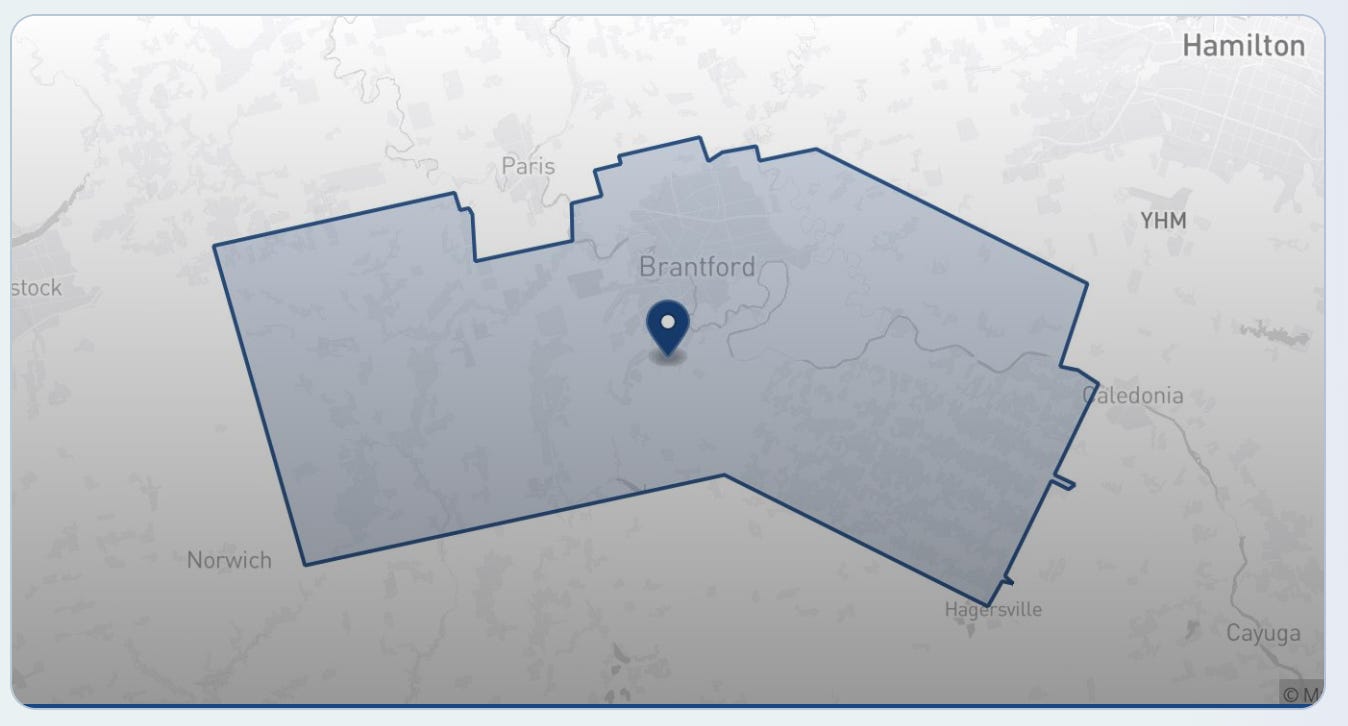
Seat projection by The Northern Vibe Project; base map ©Mapbox ©OpenStreetMap.
Up to this point, the Conservatives haven't faced a by-election where their hold on a seat looked seriously at risk. Many expect Chicoutimi–Le Fjord to flip to the Bloc or the Liberals. Our in-house model has it at 34% LPC / 30% BQ / 23% CPC, largely because of the departure of incumbent and now-Senator Richard Martel. Martel himself won the seat in a 2018 by-election with 52% of the vote, and his personal popularity runs deep, going back to his 15-year run as head coach of the Chicoutimi Saguenéens (QMJHL). That personal appeal, combined with Poilievre's unpopularity in Quebec, gives the party a ready-made excuse should it lose.
The issue also lies in other by-elections over how certain a party is likely to win. For the Conservatives, Yorkton-Melville is as unreliable as Battle River-Crowfoot last year to gauge the Conservatives’ stability. A Reform-Conservative hold since 1993, following prominent New Democrat Lorne Nystrom’s tenure from 1968 to 1993, the seat is one where Nelson Pohl is still projected to comfortably succeed at CPC 68% / LPC 18% / NDP 8%. Elsewhere, the Conservatives are unlikely to compete in five of the six other by-elections, where the Liberals or the Bloc would enter as heavy favourites, with a strong likelihood that North Vancouver-Capilano will be the closest to an upset.
All of these factors make Brantford-Brant even more important, especially as it may provide a snapshot of the region in rapidly changing times. The national polling figures have indeed suggested a declining yet still varied picture of the Conservatives’ state under an increasingly unpopular leader. But there’s still certain murkiness in the water. While the Liberals have survived Terrebonne, the Bloc eyes Chicoutimi, and the New Democrats are vying to hold Rosemont, the Conservatives have lacked an important indicator: a competitive riding they would have to fight tooth and nail over.
Right now, Brantford–Brant looks like the closest of the lot. The Northern Vibe model reads it as a TOSSUP, with this week’s polling shift showing LPC 45% / CPC 41% / NDP 8%. This gives us an interesting possibility as it is a mixed rural–urban riding that has spent the last ten years close but never quite flipping, and that makes it the Liberals' best opening: a genuine showdown with the Conservatives forced onto defence. It should still be a two-way race: the NDP vote fell here in 2025 in step with the rest of rural Ontario, and the New Democrats, outside of a possible spoiler, are unlikely to be a major factor in the by-election on their own.
A new chapter of history could be written later in the year, possibly into the new year.
Stay Seeking,
Henry, from the Northern Vibe Project
Edited by Matt
Do you live in this riding? Let us know what it’s like!
Want to see your riding featured next? Let us know!
Contact us at contact@northernvibe.ca