


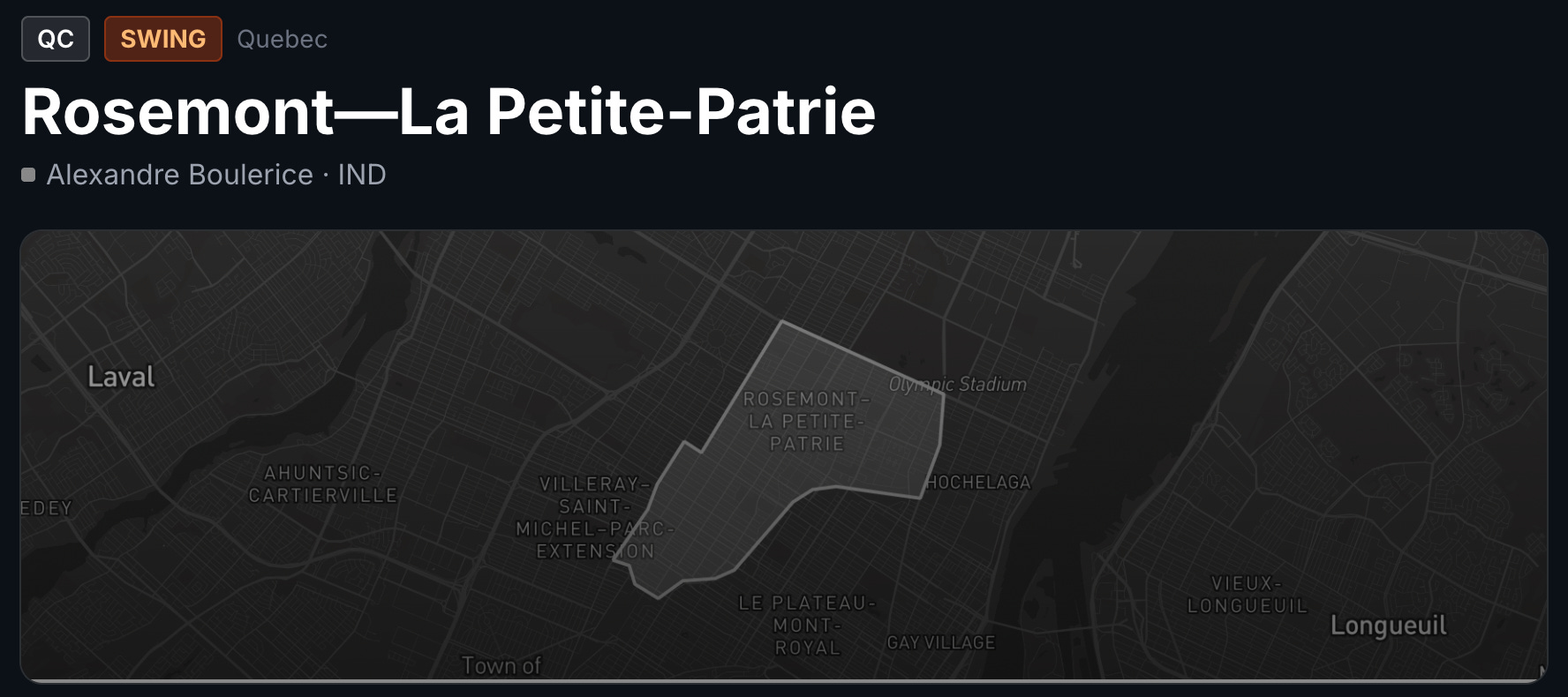
Alexandre Boulerice has held Rosemont–La Petite-Patrie since 2011, when Jack Layton’s orange wave swept through Montreal and turned one of Quebec’s most sovereigntist urban ridings into an NDP stronghold. He held it through four subsequent elections, most recently winning the 2025 election with 41% of the vote.
Then he left the NDP to sit as an independent. Now he’s expected to resign from Parliament in the coming months to run in the upcoming provincial election for the sovereigntist, left-leaning Québec Solidaire (QS).
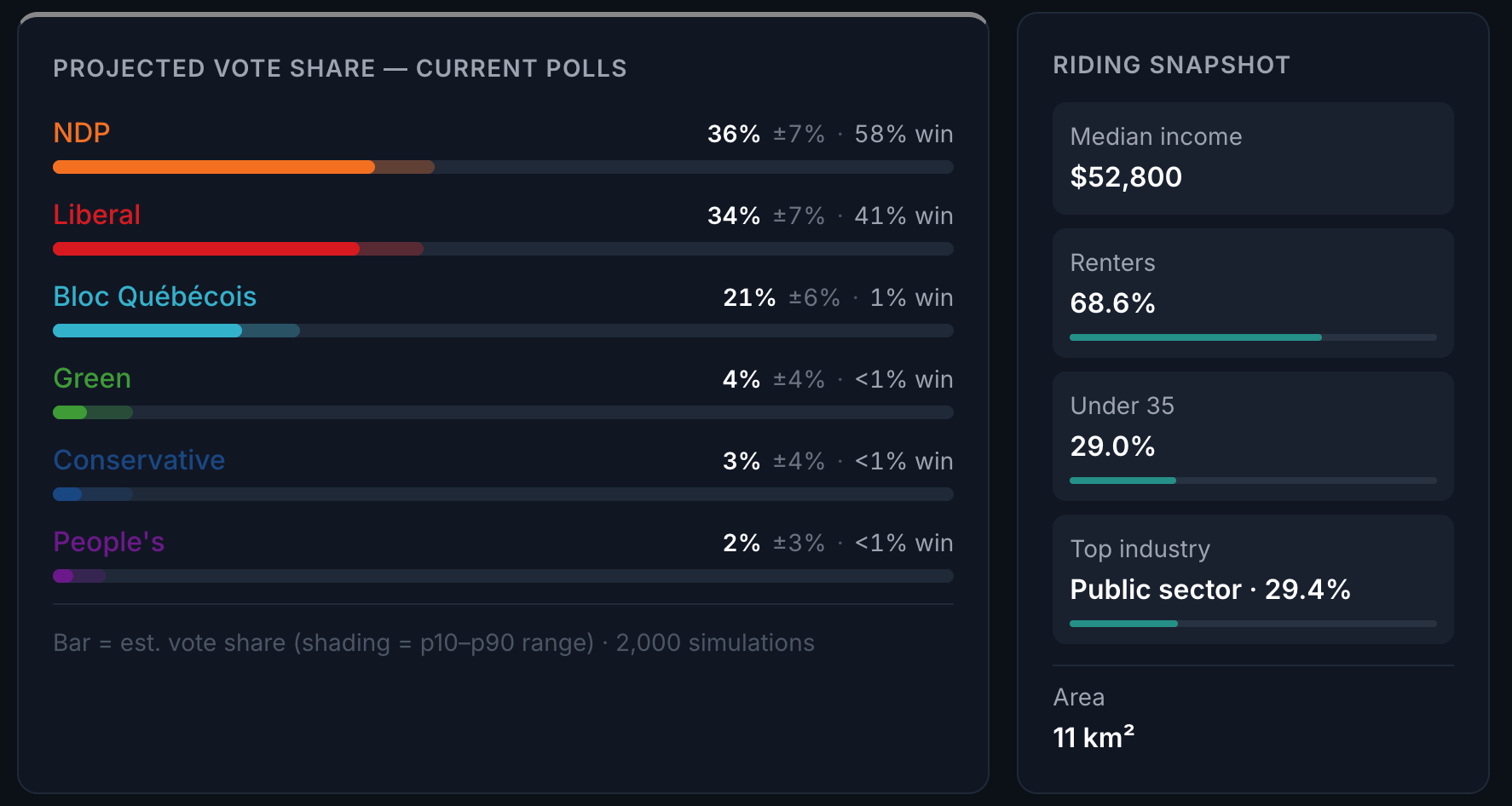
What he leaves behind is one of the most genuinely unpredictable ridings on the map: a three-way race between a weakened NDP without their biggest Quebec draw, a BQ with a natural claim on a sovereigntist electorate, and a Liberal party that wants to repeat last month’s success in the Terrebonne by-election. The simulation flags it as one of the seats it can’t model cleanly given that national polling averages don’t capture what happens when a personal-vote incumbent walks out the door.
Track this riding as polling evolves; current win probabilities for Rosemont–La Petite-Patrie
It’s a good encapsulation of where Canadian politics sits right now. The Liberals swept three by-elections on April 13 and now hold a majority at 174 actual seats, but the map still has live questions. Here’s where the current-polls simulation puts things today.
ISSUES CANADIANS CARE ABOUT
This Month: What’s on Canadians’ Minds
Data from the Northern Vibe issues pipeline as of May 3, 2026 (aggregate of weekly CTV/Nanos surveys)

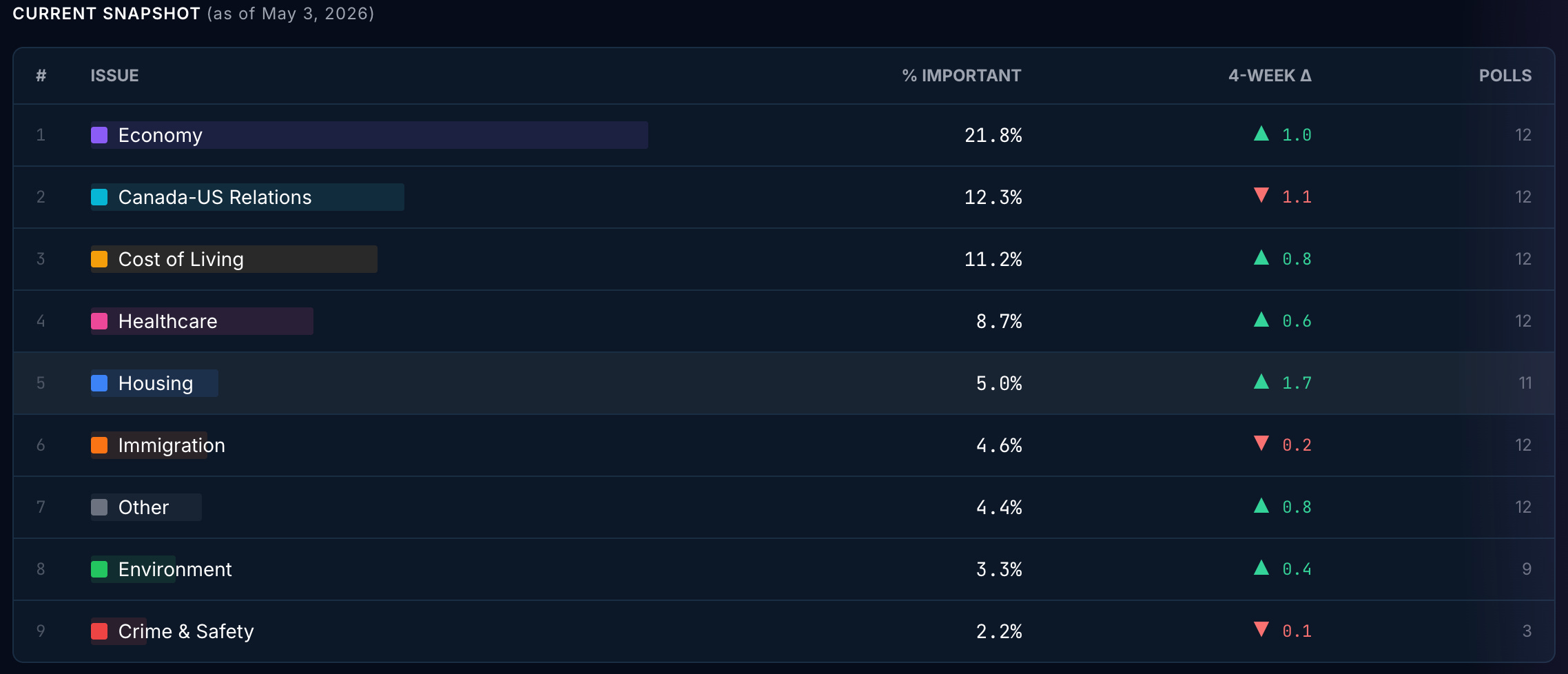
Top issues by importance this month:
Economy (21.8%) — The broadest issue category dominates by a wide margin. This is the category that contains everything from tariffs and trade to jobs and wages. In the current environment, it’s almost entirely driven by the US trade file. Coverage has run net positive for the government through Carney’s economic sovereignty argument, while simultaneously surfacing anxiety about what the USMCA review means for Canadian exports. No other issue comes close to this volume.
US Relations (12.3%) — Running at just over half the volume of the economy issue, and tightly coupled to it. The July 1 USMCA review is the forward story every political journalist is writing toward. Coverage here has run net positive for the government; the “standing up to Washington” narrative has been durable. The issue carries inherent uncertainty, though, which keeps the picture from fully settling.
Cost of Living (11.2%) — The May issues picture tells a government in a relatively strong position on the issues that matter most. Economy and US relations are generating positive coverage; cost of living is the vulnerability. The gap between the government’s macro story - sovereignty, trade diversification, housing deals - and what voters feel week-to-week (groceries, rent, affordability) is the central tension.
Coming up next: The housing file raises a deeper structural question we’ve been sitting on for a while. Why does housing matter so much politically in the first place? In our first deep-dive article, we’re going into the data on homeownership rates at the riding level and what they predict about how Canadians vote. It’s one of the sharpest demographic divides in the electoral map, sharper than income, sharper than age. We’ll show you exactly where the fault line runs.
SEAT PROJECTION SNAPSHOT
The Map This Week

Majority threshold: 172 seats · LPC majority probability: 95.8%
What this means:
The Liberals are well into majority territory if the election were held today with 213 seats, with the simulation assigning majority probability at just over 95% — confident, but not a certainty. In contrast, the Conservatives sitting at 99 seats have no current path to government. The coming months will test Pierre Poilievre’s ability to push the narrative away from trade and national unity, where Carney has dominated, and back toward cost of living and accountability, where the Conservatives have historically had more room to run. The NDP holds at 9 projected seats, consistent across recent runs, a historically weak floor with no upside momentum visible in current polling. Avi Lewis has an uphill battle in front of him, one he seems more than willing to charge at. Lewis has been pushing big ideas loudly and on his own terms in a way the party hasn’t in years. While the polling reflects a party at its floor, Lewis is betting that's the place to build from.
Keep an eye out for our issues on homeownership rates at the riding level and what they can tell us about how Canadians vote.
Stay curious,
Matt, from the Northern Vibe Team
Edited by Caitlin